We asked an AI about a company that doesn't exist. It gave us a number.
Read by a synthetic voice
Level 1 · Module 1 · Lesson 1 · 10 minutes, plus 10 minutes of practice
Checked on November 3, 2026
What you'll be able to do: predict, before you send a prompt, what the AI will see, where it's likely to miss, and what you'll have to supply or check yourself.
Same question, two answers
Harbor Point HVAC doesn't exist. We made it up, then sent an AI model this:
I run Harbor Point HVAC, a 14-person heating and cooling company in Columbus, Ohio. If I raise my prices 12% next year, what percent of my customers will leave? Give me one number and two sentences of reasoning. Answer directly, no tools.
It said 5%. We opened a new session, sent the same words, and got 4%.
Our test, November 3, 2026: Claude Haiku 5.5 in a developer tool, two passes, invented data.
Neither number has a customer behind it, because there are no customers. Both answers did say this wasn't a measurement, and told us to track our real numbers. The first also offered a range, "typically 3 to 7% for similar service businesses," with no source. Guess which part makes it into the budget meeting.
Nothing broke. OpenAI's help center says it plainly: "the same question may yield different answers across different queries." Six steps explain why, and most of the other surprises these tools hand you.
The six steps between Enter and the answer
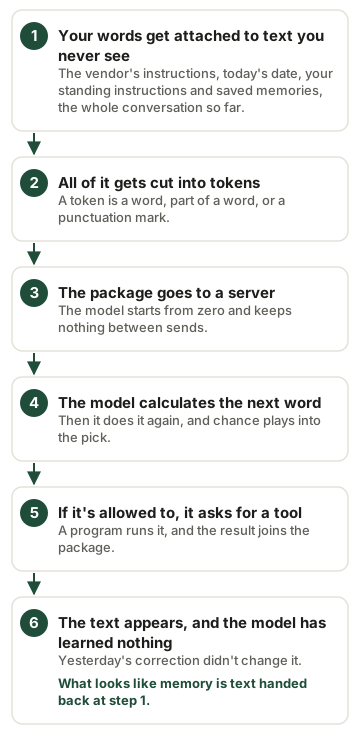
1. Your words get attached to text you never see. Ahead of your sentence, the software adds the vendor's instructions (the system prompt), today's date, your standing instructions and saved memories if those are on, and the whole conversation so far. Some vendors publish theirs, and it runs to thousands of words. The current count is in the box at the end of this lesson. You type a line. The model reads a booklet first.
2. All of it gets cut into tokens. A token is a word, part of a word, or a punctuation mark. OpenAI's rule of thumb for English: 100 tokens is about 75 words.
3. The package goes to a server, and the model starts from zero. OpenAI's developer docs call each request "independent and stateless." The model keeps nothing between sends. The software around it saves the conversation and hands it back with every message. Your 30th message makes the model reread the first 29, so a long chat uses up more of your limit.
4. The model calculates the next word, then does it again. It's made of numbers, called weights, tuned during training to predict what text comes next. Most sentences have several plausible next words, and chance plays into the pick. Anthropic says even with randomness turned all the way down, results "will not be fully deterministic." That's our 5% and our 4%.
5. If it's allowed to, it asks for a tool. The model can't search the web, run a calculator, or read a file itself. It writes a request, a program runs it, and the result joins the package. With no tool and nothing pasted in, everything comes from the weights, and the weights stop at a date the vendor publishes. That date is always before the day you ask, often by months. Current dates are in the box.
6. The text appears, and the model has learned nothing. Yesterday's correction didn't change it. What looks like memory is text handed back at step 1 (Lesson 3). Depending on your settings, your chats may train a future version (Lesson 8). They don't fix the one you're talking to.
Every Enter has a price
Models are billed by the token, and the gaps are wide. At a single vendor, the most powerful model routinely costs dozens of times more than the smallest one for the same text sent, and what comes back costs more than what goes out. Current rates are in the box.
On a subscription, the bill disappears and comes back as limits.
What to do with this
- Keep one chat per topic, because all of it gets reread every time (step 3).
- On anything important, ask twice, then check first whatever changed between answers (step 4).
- On a recent topic, turn on search or paste the document (step 5).
To see where an answer came from, add this to your prompt:
After your answer, sort what you said into three lists: what came from text I gave you, what you found with a search tool, and what came from your general knowledge. If a list is empty, write "nothing."
One more pass on Harbor Point, and the 5% came back filed under general knowledge.
That's a signal, not proof: a model can be wrong about itself. Whatever lands in the third list, you check.
What holds for the whole course
Your coach is an AI. It reviews your exercises at any hour inside the course. It sees only what you paste in. It doesn't guarantee a fact is current, won't redo your math, and won't answer a personal tax, legal, or medical question.
No real data goes into a regular account. That's our name for any personal plan, free or paid, on ChatGPT, Gemini, Claude, or Copilot. No real job, price, meeting note, or customer document goes into one, even with the names changed. You write a made-up version (Lesson 8). A business account is a team or enterprise plan under a signed contract. Your coach doesn't get customer data either.
Our tests show you where to look. Most are one pass on invented data, with a Claude model in a developer tool, so they settle nothing about ChatGPT, Gemini, or Copilot. We use Claude because it's the tool we work with, on a subscription we pay for. That's a bias you should know about. We rank no tool, and we print our prompts. "Answer directly, no tools" keeps our setup from going off to search. In prompts printed for you to keep, we've taken that line out.
Minutes and big decisions. Minutes in a method are our estimate unless we say we clocked them. On health, law, tax, and money, this is general information. You decide, with your attorney, CPA, or doctor where it applies.
What trips people up
- A good answer means one roll of the dice came up right. Before you hand off a task, test it on several cases (Lesson 4).
- The model has no clock. The apps hand it the date. In a tool that doesn't, it doesn't know what day it is.
Your turn (10 minutes)
- Pick a work question whose answer you already know: a rule in your industry, a published price in your market. Nothing about a real customer or job.
- Ask it in two new chats, same tool, word for word.
- Write two lists: "wording" for what changed in the phrasing, "substance" for what changed in the facts.
- In a third new chat, ask it again with the three-list prompt added.
- Paste all three answers and your two lists into a message to your coach. It'll check that you kept wording and substance apart, name the step behind each difference, and point to the fact to verify first.
Exit test
- Two tries, two different figures for the same rate. What do you do with that figure, and which step produced the gap?
- Why does your 40th message use more of your limit than your first?
- With no search turned on, an AI gives you a price that changed last week. Where did that number come from?
<details><summary>Answers</summary>
- Treat it as unreliable until you've checked the source. The gap comes from step 4.
- The whole conversation gets reread with every send (step 3).
- The weights, which stop at a date the vendor publishes (steps 4 and 5).
Sources, checked on the date shown:
- OpenAI, randomness: https://help.openai.com/en/articles/7842364
- OpenAI, tokens: https://help.openai.com/en/articles/4936856
- OpenAI, stateless requests: https://developers.openai.com/api/docs/guides/conversation-state
- OpenAI, cutoffs: https://developers.openai.com/api/docs/models
- Anthropic, Claude Opus 5.5 system prompt: https://platform.claude.com/docs/en/release-notes/system-prompts/claude-opus-5-5
- Anthropic, glossary: https://platform.claude.com/docs/en/about-claude/glossary
- Anthropic, tool use: https://platform.claude.com/docs/en/agents-and-tools/tool-use/overview
- Anthropic, cutoffs: https://platform.claude.com/docs/en/about-claude/models/overview
- Anthropic, pricing: https://platform.claude.com/docs/en/about-claude/pricing
- Google, Gemini limits: https://support.google.com/gemini/answer/16275805?hl=en
- Our tests: Claude Code subagents, November 3, 2026. The other lessons point back here.